This guide covers what an anonymous LLC is, which four states permit them, how to form one step by step, what legal limits apply, and the misconceptions that most commonly undermine privacy protections.
Key Takeaways
- Only Delaware, Wyoming, Nevada, and New Mexico allow anonymous LLC formation at the state public records level
- Public records anonymity stops at the state level — the IRS, courts, and banks will still know who you are
- As of March 2025, domestic LLCs are exempt from federal BOI reporting under FinCEN's interim final rule
- Florida residents cannot form an anonymous LLC directly in Florida; a double-LLC structure is typically required
- Small missteps — like listing yourself as registered agent — can break your anonymity
What Is an Anonymous LLC?
An anonymous LLC works the same as a standard LLC — limited liability protection, pass-through taxation, operational flexibility — with one key difference: member and manager names are kept off public state business records.
In practice, anonymity is achieved by having a commercial registered agent or professional organizer file the formation documents on the owner's behalf. The registered agent's name appears in public filings instead of the owner's.
Common users of this structure:
- Real estate investors who don't want tenants, competitors, or litigation targets to trace property ownership
- Landlords managing multiple properties who prefer operational separation
- Business owners in sensitive or competitive industries
- High-profile individuals with privacy concerns about searchable public records
One important clarification: "anonymous" does not mean invisible to everyone. The IRS, federal agencies, and courts all retain legal authority to access ownership information. Anonymous LLCs are not a tool for hiding assets or evading obligations — they are a tool for keeping your name out of publicly searchable databases.
Best States for Anonymous LLC Formation
Only four states currently allow true anonymous LLC formation. Owners living or operating in other states may still need to register as a foreign entity in their home state, which affects how much privacy is ultimately achievable.
Delaware
Delaware's Certificate of Formation requires the LLC name, a Delaware registered office address, the registered agent's name, and an authorized person's signature — but no member or manager names. Additional features:
- Formation fee: $110
- Annual tax: $300 (due June 1), with no annual franchise-tax report required
- Court of Chancery: A specialized business court that handles contested LLC management disputes efficiently
Delaware is a strong choice for complex business structures or entities that may face internal governance disputes.
Wyoming
Wyoming's Articles of Organization require registered agent and organizer information, but not member or manager names. Key details:
- Formation fee: $100
- Annual fee: The greater of $60 or $0.0002 per dollar of Wyoming-based assets
- No state personal or corporate income tax
Wyoming does not have a formally recognized statutory "nominee member" or "nominee manager" role. An organizer can sign without being a member, but nominee ownership and organizer services are not the same thing.
Nevada
Nevada offers strong asset protection: under NRS 86.401, a charging order is the exclusive creditor remedy against a member's interest. There is a notable anonymity limitation, though. A member-managed LLC must name its initial members, and a manager-managed LLC must name its initial managers.
- Total initial costs: $425 ($75 Articles + $150 Initial List + $200 state business license)
- Annual List: Ongoing disclosure requirement that can expose ownership
- No personal income tax, but a Commerce Tax applies to businesses with Nevada gross revenue over $4 million
Nevada is best suited for multi-member or manager-managed structures where a separate manager can be named without identifying the true owner.
New Mexico
New Mexico is the most cost-effective option and does not require member or manager names in its formation documents.
- Formation fee: $50 (one-time)
- No LLC annual report requirement
- No franchise tax — unless the LLC elects corporate tax treatment, in which case a $50 annual franchise tax applies
- Personal income tax applies to New Mexico residents and qualifying nonresidents
New Mexico suits budget-conscious owners who want basic privacy without ongoing state reporting obligations.
Choosing the Right State
| State | Formation Fee | Annual Cost | Income Tax | Anonymity Strength |
|---|---|---|---|---|
| Delaware | $110 | $300 | None | Strong |
| Wyoming | $100 | $60+ | None | Strong |
| Nevada | $425 | $350+ | None (with limits) | Conditional |
| New Mexico | $50 | None | Yes | Strong |
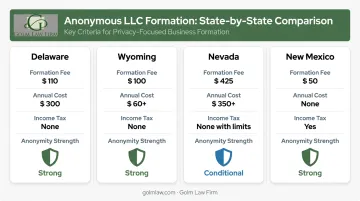
The right choice depends on your priorities: cost, asset protection, tax environment, and whether you'll operate across multiple states. Florida-based owners should consult a business attorney before choosing. The formation state affects the entire privacy strategy, particularly when cross-state foreign registration requirements come into play.
How to Form an Anonymous LLC: Step-by-Step
Forming an anonymous LLC follows the same general process as a standard LLC, with critical differences at each stage. Any misstep can break anonymity entirely.
Step 1: Choose a Privacy-Friendly State
Select one of the four permissible states based on your fee tolerance, tax situation, and asset protection needs. If you'll operate in Florida, you also need to plan upfront for how the double-LLC structure will work across both registrations — the two filings must be coordinated from the start.
Step 2: Appoint a Commercial Registered Agent
The registered agent's name and address appear in every state's public formation records. Never serve as your own registered agent for an anonymous LLC.
A commercial registered agent service uses its own name and address in public filings, keeping the owner's identity off the record. Current market rates run $125–$299 per year for the majority of mass-market providers. The registered agent must be located in the state of formation.
Step 3: File the Articles of Organization
In privacy-friendly states, the Articles of Organization do not require member or manager names — only the LLC name and registered agent details. An organizer (the registered agent service itself, or an attorney) can file on the owner's behalf, adding another layer of separation from public records.
State-specific note: Delaware uses a "Certificate of Formation" rather than Articles of Organization, but the privacy mechanics are the same. New Mexico requires a statement about whether the LLC is manager-managed and whether it has a single member, but does not require the actual names.
Step 4: Draft a Private Operating Agreement
The operating agreement is never filed with the state. Keep it private. This document:
- Proves ownership when public filings don't identify you
- Outlines member rights, management authority, and decision-making processes
- Becomes essential when opening bank accounts, obtaining loans, or demonstrating ownership in legal proceedings
Without a properly drafted operating agreement, proving you own the LLC becomes difficult — especially when your name appears nowhere in public records.

Step 5: Obtain an EIN and Open a Business Bank Account
The IRS requires a named "responsible party" when applying for an EIN via Form SS-4. Nominees cannot serve as the responsible party — it must be the individual who ultimately controls the entity. This information goes to the IRS, not state public records, and is protected under IRC Section 6103.
Banks are legally required to verify owner identity under FinCEN's Customer Due Diligence rule, which covers individuals owning 25% or more of the LLC plus one control person. When opening a business account, be prepared to provide:
- The private operating agreement
- EIN documentation
- Proof of ownership
For Florida-based owners: Florida Statute 605.0902 will likely require a foreign LLC registration if the LLC conducts business in Florida. That filing requires disclosure of at least one person authorized to manage the LLC.
This is where the double-LLC structure becomes necessary. Working with a Florida business attorney like Golm Law Firm helps structure the arrangement to maintain privacy while keeping the registration fully compliant.
Key Legal Requirements, Limitations & Ongoing Compliance
What "Anonymous" Actually Means
Anonymous means hidden from public state records — not untraceable. The following can compel owner disclosure regardless of your formation state:
- IRS audits and federal agency investigations
- Court subpoenas and legal discovery
- Diversity jurisdiction filings (Federal Rule of Civil Procedure 7.1, amended December 1, 2022, requires LLC parties to identify member citizenship)
In D.B. Zwirn Special Opportunities Fund v. Mehrotra, the First Circuit required disclosure of every LLC member to establish federal jurisdiction — not as a penalty for wrongdoing, but as a routine procedural requirement.
BOI Reporting Under the Corporate Transparency Act
Under FinCEN's March 2025 interim final rule, all U.S.-created entities are currently exempt from Corporate Transparency Act BOI reporting. Domestic LLCs formed in Delaware, Wyoming, Nevada, New Mexico, or Florida presently have no active CTA filing deadline.
Foreign entities registered to do business in the U.S. remain subject to reporting requirements. This rule continues to evolve — verify current requirements before finalizing any formation.
Ongoing State Compliance
Failing to maintain good standing eliminates all privacy protections. Annual obligations vary by state:
- Delaware: $300 annual tax
- Wyoming: Annual report with license tax calculation
- Nevada: Annual List ($150) + business license renewal ($200)
- New Mexico: No annual report, but franchise tax if electing corporate treatment
The Double-LLC Structure for Florida Owners
Florida presents a specific challenge: under Fla. Stat. 605.0212, annual reports must disclose current managers and persons authorized to manage the LLC. A single anonymous LLC registered in Wyoming or New Mexico won't protect a Florida owner who then registers it directly as a foreign entity.
The double-LLC structure works like this:
- Form an anonymous LLC in Wyoming or New Mexico (the "parent")
- Form a second LLC registered in Florida (the "operating entity")
- The Florida LLC lists the anonymous LLC as its sole member — not the individual owner
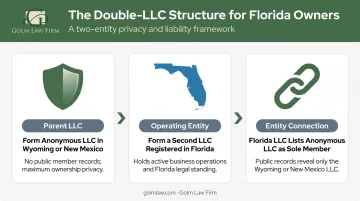
Florida Statute 605.0905 confirms that merely owning a Florida LLC does not, by itself, constitute transacting business in Florida. The Wyoming or New Mexico parent can therefore own the Florida entity without triggering foreign qualification — but only if the structure is documented and maintained correctly. An attorney should establish the operating agreement, member designations, and entity relationship from the outset.
Common Misconceptions About Anonymous LLCs
Several persistent myths surround anonymous LLCs — and believing them can expose you to serious legal and privacy risks. Here's what the law actually says.
Misconception 1: An anonymous LLC hides you from everyone. Courts regularly pierce anonymity for fraud, tax evasion, and regulatory violations. An anonymous LLC is a legal privacy tool — not a shield against legal obligations.
Misconception 2: Any LLC formation provides privacy. Most states require owner disclosure in public filings. Florida's annual report specifically requires current manager and authorized person information. Only four designated states offer anonymity at the public records level — and only when formation steps are followed correctly.
Misconception 3: Anonymity is permanent once the LLC is formed. Anonymity can be lost through seemingly routine mistakes:
- Signing contracts in your personal name without LLC authority language
- Registering as your own registered agent in another state
- Letting annual filings lapse
- Publicly associating yourself with the LLC on social media or marketing materials
Misconception 4: Any business can use this structure. Businesses requiring professional licenses — contractors, healthcare providers, real estate agents — as well as government contractors and some consumer-facing businesses may be legally required to disclose ownership. For those, an anonymous structure is often impractical or legally unworkable.
Frequently Asked Questions
How much does it cost to form an anonymous LLC?
State filing fees range from approximately $50 (New Mexico) to $425 (Nevada), plus commercial registered agent fees of $125–$300 per year and any attorney or professional filing fees. Check current state fee schedules before filing, as these figures can change.
Is an anonymous LLC legal?
Yes. Anonymous LLCs are entirely legal when properly formed and operated for legitimate purposes. They become illegal only if used to commit fraud, evade taxes, or circumvent legal obligations — in which case courts will disregard the structure entirely.
Can I form an anonymous LLC if I live in Florida?
Florida does not permit anonymous LLC formation directly. Florida residents can form an anonymous LLC in Wyoming or New Mexico and use a double-LLC structure to operate in-state — but this requires careful coordination with a Florida business attorney to stay compliant while maintaining privacy.
Does an anonymous LLC protect me from lawsuits?
An anonymous LLC provides the same limited liability protection as a standard LLC, but it does not prevent lawsuits or shield owners from legal proceedings. If a lawsuit is filed, courts can order disclosure of owner identities through legal discovery or subpoena.
Can an anonymous LLC open a bank account?
Yes, but the bank must verify owner identity under federal law. Be prepared to provide the private operating agreement, EIN documentation, and proof of ownership — this information stays with the bank and does not become part of public state records.
Do I need a lawyer to form an anonymous LLC?
Legal counsel is strongly recommended, particularly for Florida residents — any error in the formation process, from the registered agent to the double-LLC structure, can inadvertently expose owner identity or create a non-compliant arrangement. Golm Law Firm offers consultations starting at $150 for targeted questions about LLC formation.