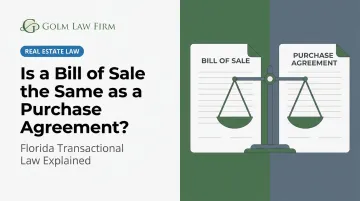
These two documents serve distinct legal purposes, operate at different points in a transaction, and carry different consequences if missing. This article explains what each document is, how they differ, and when Florida transactions require one, the other, or both.
Key Takeaways
- A purchase agreement sets the terms before a sale closes; a bill of sale confirms ownership has transferred after the fact.
- Purchase agreements include contingencies, payment terms, and closing conditions — bills of sale are simpler transfer receipts.
- Many transactions, particularly real estate closings, use both documents in sequence.
- Asset type, transaction complexity, and Florida law all determine which document — or both — you actually need.
What Is a Purchase Agreement?
A purchase agreement is a legally binding contract signed before ownership transfers. It documents the terms both parties must satisfy before the transaction closes. You'll also see it called a sales contract, contract of purchase, or — in real estate — a real estate purchase contract.
Its primary function is protection: the purchase agreement defines each party's obligations, establishes what happens if conditions aren't met, and creates enforceable remedies before any money or property changes hands.
What a Purchase Agreement Covers
A well-drafted purchase agreement typically includes:
- Identification of parties: full legal names of buyer and seller
- Asset or property description: specific enough to avoid disputes
- Purchase price and payment terms: including deposit amounts and financing details
- Contingencies: conditions that must be met before the sale proceeds
- Closing date: when the transfer is expected to occur
- Default and termination clauses: what happens if either party walks away
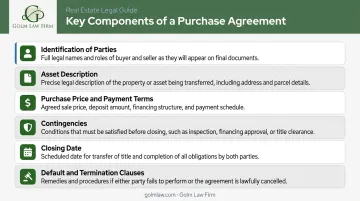
Of those elements, contingencies carry the most weight. A financing contingency allows a buyer to exit the agreement without penalty if they can't secure a mortgage. An inspection contingency gives the buyer a window to evaluate the property's condition and negotiate repairs. These provisions define when a party can legally exit — and when they can't.
Florida-Specific Requirements
Florida Statute 725.01 requires that any contract for the sale of land or interest in land be in writing and signed by the party to be charged to be enforceable. For goods priced at $500 or more, Florida's UCC (Chapter 672) similarly requires a written record.
The Florida Realtors/Florida Bar AS IS Residential Contract (ASIS-7) is the standard form used in most Florida residential transactions. It includes financing terms in Paragraph 8, inspection rights in Paragraph 12, and default periods — typically 30 days for loan approval and 15 days for inspections.
For buyers and sellers in Bradenton, Sarasota, and surrounding Manatee County areas, having an attorney review the purchase agreement before signing ensures contingency clauses are structured to protect your interests — not just fulfill a formality.
What Is a Bill of Sale?
A bill of sale is a written document confirming that a transaction has been completed and ownership has transferred from seller to buyer. Think of it as a formal receipt: it doesn't create obligations or set conditions, it confirms that a transfer already happened.
What a Bill of Sale Should Include
- Names and addresses of both buyer and seller
- Date of sale
- Detailed description of the item or property transferred
- Purchase price and payment method
- Condition of the item, including any "as-is" disclaimer
- Signatures of both parties
The "As-Is" Provision
Sellers can use as-is language to disclaim implied warranties — specifically, the UCC's implied warranties of merchantability and fitness for a particular purpose. Florida Statute 672.316 allows these exclusions when the language conspicuously calls the buyer's attention to it.
There are limits, though. Motor vehicle dealers must provide as-is disclaimers in writing, conspicuously, and in plain terms under Florida Statute 501.976. And Florida's Lemon Law (Chapter 681) covers new vehicles for 24 months after original delivery — any agreement attempting to waive those rights is void.
Common Uses in Florida
- Vehicle sales: Florida uses FLHSMV Form HSMV 82050, a combined Notice of Sale and Bill of Sale capturing vehicle identification, parties, price, date, and odometer disclosures
- Vessel transfers: Florida Statute 328.46 allows a vessel to be operated for 30 days after purchase if the buyer keeps a bill of sale with specific statutory information aboard
- Personal property in real estate closings: appliances, furniture, and equipment transferred alongside a property
A bill of sale is not the same as a title. A Florida certificate of title is the official, state-issued proof of vehicle or vessel ownership. A purchaser doesn't acquire marketable title until a certificate is issued — the bill of sale supports that process, but the certificate is what legally establishes ownership.
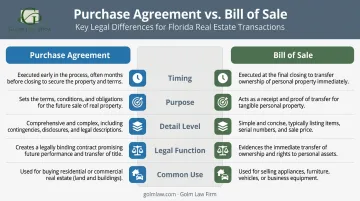
Key Differences: Bill of Sale vs. Purchase Agreement
| Feature | Purchase Agreement | Bill of Sale |
|---|---|---|
| Timing | Before ownership transfers | At or after the transfer |
| Purpose | Sets terms and conditions | Confirms completed transfer |
| Detail level | Comprehensive (contingencies, remedies, timelines) | Concise (who, what, how much, when) |
| Legal function | Creates enforceable obligations | Serves as evidence of completed transfer |
| Common use | Real estate, business asset sales | Vehicles, equipment, personal property |
Legal Enforceability
Both documents are legally binding once signed — but in different ways. A purchase agreement creates obligations before the sale is complete. If a party backs out without a valid contractual reason (such as an unmet contingency), they may face damages or a lawsuit for specific performance. In Florida real estate contracts, for example, the ASIS-7 agreement addresses this in Paragraph 15, and Florida Statute 672.716 authorizes specific performance for unique goods.
A bill of sale serves a different purpose: it protects against post-transfer disputes. It's the document you produce when someone later questions who owns an asset and when that ownership changed.
When Are Both Documents Used in the Same Transaction?
In most real estate transactions and many larger asset deals, both documents appear — just at different stages.
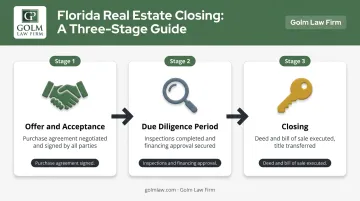
The Typical Sequence in a Florida Real Estate Closing
- Offer and acceptance — Buyer and seller sign a purchase agreement outlining price, contingencies, and closing date
- Due diligence period — Inspections, financing approval, and title examination occur under the agreement's contingency framework
- Closing — A deed transfers the real property; a bill of sale transfers any personal property included in the deal
The Florida Realtors/Florida Bar ASIS-7 contract addresses this directly. Paragraph 1(d) identifies personal property included in the sale, and Standard H requires that such property be transferred at closing by an absolute bill of sale with warranty of title.
So in a residential transaction where the seller is including appliances and a riding mower, the purchase agreement governs the overall deal while a bill of sale handles the personal property transfer at the closing table. Each document has a defined role — and neither replaces the other.
Vehicle and Equipment Sales With Financing
The same two-stage structure applies when financing is involved in vehicle or equipment sales. The purchase agreement does the heavy lifting upfront:
- Locks in the purchase price and delivery date
- Documents condition representations and any warranties
- Protects both parties during the gap between signing and payment
Once the buyer takes possession and funds clear, the bill of sale is issued — confirming the transfer and completing the transaction record.
Which Document Do You Need?
The answer usually comes down to two questions: Is there a gap between agreement and transfer? And are there conditions that need to be met before the deal should close?
Use a bill of sale when:
- Ownership and payment transfer simultaneously (cash transaction, item in hand)
- The asset is personal property with no complex conditions
- You need documented proof of a completed private sale (vehicle, boat, equipment)
Use a purchase agreement when:
- There's a gap between signing and closing
- Financing, inspections, or appraisals need to be satisfied first
- The transaction involves real estate, business assets, or significant value
- You need enforceable protections if something falls through
Use both when:
- The transaction is a real estate closing (purchase agreement first, deed and bill of sale at closing)
- Personal property is included in a larger deal
- A vehicle or equipment sale involves future delivery or financing
Getting this wrong carries real consequences. Relying on only a bill of sale in a transaction that needs a purchase agreement leaves you without legal recourse if the deal falls apart before closing.
The reverse is equally problematic. Skipping the bill of sale in a personal property transfer leaves the buyer without documented proof of ownership — a problem that surfaces when registering a vehicle or resolving a dispute later on.
If you're navigating a Florida real estate or personal property transaction and aren't sure which documents apply, Golm Law Firm works with buyers, sellers, investors, and developers across Bradenton, Sarasota, Manatee County, and Southwest Florida. Services include purchase agreement drafting and review, FSBO contract preparation ($1,200 flat rate), and full buyer/seller representation ($1,500 flat rate). A 60-minute consultation with document review runs $350 — credited toward any flat-rate service you retain.
Frequently Asked Questions
Is a purchase agreement the same as a bill of sale?
No. A purchase agreement sets the terms before a sale is finalized, while a bill of sale confirms ownership has transferred at or after the point of sale. Both relate to property transactions, but they operate at different stages and serve different legal functions.
How legally binding is a purchase agreement?
A purchase agreement is fully binding once signed by both parties. A party who backs out without a valid contractual reason — such as an unmet contingency — may face damages or a lawsuit for specific performance under Florida law.
Is a handwritten bill of sale legitimate?
A handwritten bill of sale can be legally valid as long as it includes the essential elements: parties, description of the item, price, date, and signatures. Professionally drafted documents reduce the risk of disputes over ambiguous or missing terms.
What is another name for a purchase agreement?
A purchase agreement may also be called a sales contract, contract of sale, contract of purchase, or — in real estate — a real estate purchase contract or purchase and sale agreement. In Florida, "purchase and sale agreement" is common in residential real estate contexts.
Do you need both a purchase agreement and a bill of sale?
In many transactions, yes. The purchase agreement governs the terms before closing; the bill of sale (or deed, for real property) formalizes the transfer at closing. Florida's standard residential contract (ASIS-7) explicitly requires a bill of sale for personal property transferred alongside real property.
Does a bill of sale need to be notarized in Florida?
Florida does not universally require notarization for a bill of sale. Vehicle transfers use Form 82050 with a perjury certification rather than a notary block, though notarization is recommended. Requirements vary by asset type and county, so confirm with an attorney before proceeding.