This is exactly the scenario a Purchase and Sale Agreement (PSA) exists to prevent. Before ownership changes hands, a PSA documents every agreed-upon term — price, contingencies, timelines, and what happens if something goes wrong.
This guide covers what a PSA is, what it must include, how contingencies work, and why having an attorney review it matters — particularly in Florida real estate transactions.
Key Takeaways
- A PSA is a legally binding contract that governs the transaction from offer acceptance through closing.
- Signing a PSA is not the same as closing — it sets the process in motion.
- Core elements include the purchase price, earnest money, contingencies, closing date, and default remedies.
- Contingencies protect both parties by creating exit options when key conditions aren't met.
- In Florida, an attorney review before signing can catch problematic clauses before they become costly problems.
What Is a Purchase and Sale Agreement?
The American Bar Association describes the PSA as an executory contract — meaning each party promises future performance if stated conditions are met. It's the transaction's pre-closing road map: it sets conditions, allocates risks, requires disclosures, and specifies remedies if either party fails to perform.
A PSA is not the final transfer of ownership. It creates mutual obligations and advances the transaction toward closing. The document goes by several names:
- Purchase and sale agreement
- Sale and purchase agreement
- Contract for sale and purchase
The terminology varies, but the function is identical across all three.
PSAs are most common in real estate (residential and commercial), but also appear in business acquisitions and high-value asset sales where multiple conditions must be satisfied before a deal can close.
PSA vs. Purchase Agreement
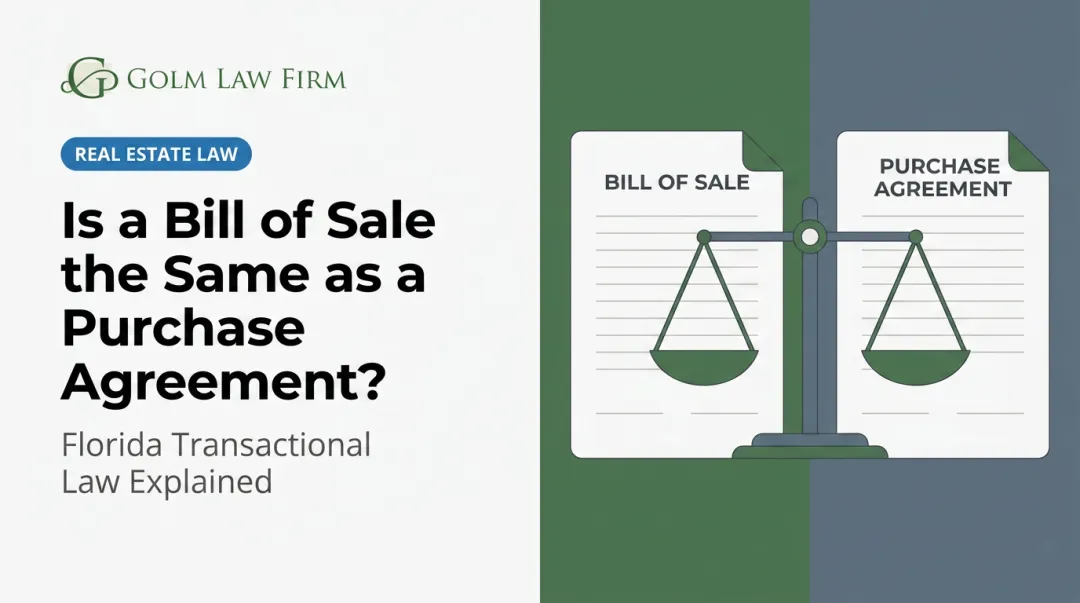
These terms get used interchangeably, and in most Florida residential transactions, they refer to the same document. The PSA governs everything between offer acceptance and closing — contingencies, inspections, timelines. A "final purchase agreement" or closing document confirms that all conditions have been satisfied and ownership is transferring.
The key distinction: a PSA is the working document that manages the process; a closing document records the result. Understanding that difference also clarifies how a PSA compares to other preliminary agreements.
PSA vs. Letter of Intent vs. Purchase Order
| Document | Binding? | Purpose |
|---|---|---|
| PSA | Yes (once signed) | Governs full transaction through closing |
| Letter of Intent (LOI) | Often no | Outlines preliminary terms before formal negotiation |
| Purchase Order | No (for asset transfers) | Orders goods or services — not property or business assets |
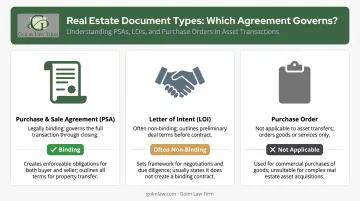
The ABA notes that LOIs are often designed to be nonbinding, but careless drafting can make them enforceable. A signed PSA, by contrast, creates clear legal obligations the moment both parties execute it.
Key Elements of a Purchase and Sale Agreement
A well-drafted PSA must include specific components to be legally enforceable. Florida's Statute of Frauds requires that any contract for the sale of land be in writing and signed by the party against whom enforcement is sought.
The 2026 Florida Realtors/Florida Bar AS IS Residential Contract is the benchmark form for residential transactions, but it's a contractual standard, not a legal requirement.
Here's what every Florida PSA should address:
Parties, Property Description, and Purchase Price
- Parties: Use full legal names for individuals and registered entity names — not trade names — for businesses. The wrong name can invalidate the contract or bind the wrong party.
- Property description: Use the legal property description — not just the street address. Include boundaries, easements, and a clear list of what fixtures or personal property are included or excluded. Vague descriptions are where post-signing disputes start.
- Purchase price and payment terms: State the total price and specify how it will be paid — cash, conventional financing, seller financing. Any conditions tied to payment should be spelled out here.
Earnest Money, Closing Date, and Title
- Earnest money deposit: The PSA specifies the amount, payment deadline, and who holds it (typically an escrow agent). If the deal closes, it's credited toward the purchase price. If a party defaults without a valid contingency, the seller may retain it as liquidated damages.
- Closing date: This is when ownership officially transfers and when all contingencies must be satisfied. The agreement should also address how extensions are handled and what notice is required.
- Title: The PSA identifies the title company, describes how title will be transferred and insured, and specifies who pays for title insurance. Florida law requires a clear and marketable title for any real estate closing — if a purchase agreement doesn't specify, the seller must furnish good and marketable title.
Disclosures, Default, and Remedies
Florida sellers carry specific disclosure obligations:
- Johnson v. Davis: Sellers must disclose known facts that materially affect the property's value and aren't readily observable to a buyer. An "as is" clause does not eliminate this duty.
- Fla. Stat. § 689.261: Requires a property tax disclosure at or before contract execution.
- Fla. Stat. § 689.302: Requires a flood disclosure, covering insurance coverage and prior flood damage claims.
Disclosure obligations and default provisions work together — both define what happens when a party fails to meet their contractual duties. The default and remedies section specifies what constitutes a breach, what notice is required, and what options the non-defaulting party has: deposit forfeiture, damages, contract termination, or specific performance (a court order forcing the sale to proceed).

Common Contingencies in a Purchase and Sale Agreement
Contingencies are conditions that must be satisfied before the transaction can proceed to closing. Think of them as structured exit options — each one defines the specific circumstances under which a party can walk away without penalty.
According to NAR's June 2026 survey, 6% of contracts were terminated during the preceding three months, with 13% experiencing delays. Knowing how each contingency works — and when it applies — is what separates a well-protected buyer or seller from one caught off guard at closing.
Core Contingencies to Know
Financing contingency
Allows the buyer to exit and recover their earnest money if they can't secure acceptable mortgage financing within the specified timeframe. Under the 2026 Florida AS IS form, the default loan-approval period is 30 days if the blank is not completed. This is one of the most frequently negotiated contingencies in residential deals.
Inspection contingency
Gives the buyer the right to have the property professionally inspected and — based on findings — request repairs, a price reduction, or cancellation. The Florida AS IS form defaults to a 15-day inspection period after the effective date. The PSA should define both the period and the process for requesting remedies.
Appraisal contingency
Protects the buyer if the lender's appraisal comes in below the purchase price. The buyer can renegotiate, or exit the contract without losing their deposit if the seller won't adjust. NAR's June 2026 survey found 17% of buyers waived this contingency — a meaningful risk in a competitive market.
Title contingency
Ensures the buyer receives a clear, marketable title free of liens, encumbrances, or ownership disputes. If title problems can't be resolved before closing, the buyer can cancel. In Florida, this matters more than many buyers expect — unreleased mortgages, missing satisfactions, and gap-period liens can surface during the title search and delay or derail a closing.
How a PSA Works: From Signing to Closing
The signing sequence matters. The buyer prepares and signs the PSA first, submitting it as a formal offer. The seller then accepts, rejects, or counters with modified terms. This exchange continues until both parties sign identical terms.
At that point, the PSA becomes legally binding. Neither party can exit without consequence unless a valid contingency applies.
What happens between signing and closing:
- Buyer conducts inspections, applies for financing, and reviews the title report
- Seller prepares required disclosures and addresses any inspection items agreed upon
- Both parties negotiate any modifications through signed addenda — verbal agreements don't count
- All contingencies must be satisfied (or waived) before the closing date arrives
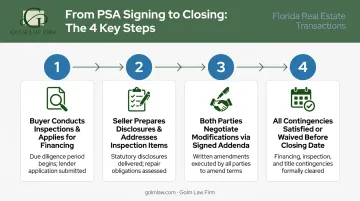
NAR data consistently places the national median around 30 days from contract to closing. Florida transactions vary from that figure based on financing type, inspection findings, and title complexity.
Here's a concrete example: a buyer signs a PSA on a Bradenton home with a 15-day inspection period and a 45-day closing date. During that window, the buyer's inspector flags a roof issue. The parties negotiate a price reduction, formalize it in a signed addendum, the lender's appraisal comes in at value, and title clears. On day 45, final closing documents are signed and ownership transfers.
Think of the PSA as a roadmap: it sets every condition that must be met before ownership can legally transfer.
Do You Need an Attorney to Review Your PSA in Florida?
Florida does not require an attorney for all real estate transactions. Fla. Stat. 627.7711 defines "closing services" as services performed by a licensed title insurer, title insurance agent, or attorney agent — not attorneys exclusively.
That said, the Florida Bar's consumer guidance is direct: "Contract provisions often cannot be changed after signing without the seller's approval, and the law assumes a signer read and understood the contract." The current Florida Realtors/Florida Bar form itself states it is legally binding and directs parties who don't fully understand it to seek legal counsel before signing.
What's at stake if you skip attorney review:
- Losing an earnest money deposit due to a poorly worded or missing contingency
- Being legally obligated to complete a purchase you can no longer finance
- Missing seller disclosure requirements that create post-closing liability
- Facing specific performance litigation if your exit from the contract wasn't contingency-supported

Golm Law Firm offers a 60-minute consultation at $350 that includes document review — the attorney reviews your PSA before the meeting and provides a tailored risk assessment. If you move forward with representation, the consultation fee applies toward the flat-rate service cost. Buyer and seller representation is available at a $1,500 flat rate, and FSBO contract preparation (drafting and review of contracts, riders, and disclosures) is offered at $1,200.
For Commercial Transactions
Commercial deals carry different risks entirely. PSAs for apartment complexes, office buildings, shopping centers, and triple-net leases often span dozens of pages with complex due diligence periods, regulatory approval contingencies, and custom default provisions.
Principal attorney Crystal D. Golm has closed hundreds of millions of dollars in commercial transactions across Manatee County and Southwest Florida. The firm's integrated approach also means your closing attorney serves as your escrow agent — a meaningful advantage when earnest money disputes arise.
Frequently Asked Questions
What is the purpose of a purchase and sale agreement?
A PSA documents the agreed-upon terms between buyer and seller before closing and creates legally enforceable obligations for both parties. It also establishes a clear roadmap for completing the transaction, covering contingencies, timelines, and remedies if something goes wrong.
Is a purchase and sale agreement the same as closing?
No. The PSA is signed before closing and sets the conditions that must be met. Closing is the final step where all conditions have been satisfied, final documents are signed, and ownership officially transfers from seller to buyer.
What happens after signing a purchase and sale agreement?
Once both parties sign, the transaction enters the contingency period. Buyers conduct inspections, secure financing, and review the title report — while sellers fulfill their disclosure obligations. If all contingencies are satisfied, the transaction proceeds to closing on the agreed date.
Who prepares a purchase and sale agreement in Florida?
A PSA may be prepared by the buyer's real estate agent using a standard form, or by a real estate attorney — particularly in complex, commercial, or high-value transactions. An attorney should review the document before signing, regardless of who drafts it.
Can you back out of a purchase and sale agreement?
Yes — but only without penalty if a valid contingency applies, such as failed financing or an unsatisfactory inspection. Walking away without a valid contingency can mean losing your earnest money deposit or facing a breach of contract claim.