These questions come up more often than most people expect — and the answers depend almost entirely on what the contract actually says. Florida does not automatically terminate a purchase agreement because a closing date passed. Whether a contract ends, who owes what, and what happens to the earnest money deposit all turn on the specific language in the agreement.
This article explains how maximum termination dates work in Florida real estate contracts, how the FR/BAR standard forms treat closing deadlines, what happens when those dates pass, and how buyers and sellers can protect themselves before signing anything.
Key Takeaways
- Florida law does not automatically end a purchase agreement when a closing date passes — contract language controls the outcome.
- Missing a closing date under Florida's standard FR/BAR forms typically creates a default, not an automatic termination.
- Extending the closing date in writing does not automatically extend the loan approval period or other contingency deadlines.
- Verbal extensions are unenforceable in Florida real estate transactions.
- Earnest money disputes require formal procedures; escrow agents cannot release funds simply because a deadline passed.
What Is a Maximum Termination Date in a Real Estate Purchase Agreement?
The phrase "maximum termination date" does not appear in Florida statutes or in the current FR/BAR standard forms. It functions as a contract-specific term — a hard deadline drafted into a purchase agreement that sets an absolute cutoff for the transaction.
How It Differs from a Standard Closing Date
A standard closing date tells the parties when they intend to close. When that date passes without a closing, the contract does not simply disappear. Florida Realtors confirms that a missed closing date leaves the contract intact — the next question is whether a breach occurred and who caused it.
A true maximum termination date, by contrast, is written to function as an automatic cutoff. When the clause uses language like "this contract shall automatically terminate," the agreement ends on that date without either party needing to serve notice or take any further action.
The difference between these two mechanisms matters enormously:
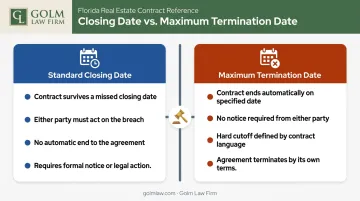
- Standard closing date: The contract survives a missed closing. Either party must then act on the breach — it does not resolve itself.
- Maximum termination date with automatic language: The contract ends by its own terms on the specified date, with no notice required from either side.
"Time Is of the Essence" and What It Does
Both the Rev. 12/24 FR/BAR Residential Contract (FloridaRealtors-FloridaBar-7) and the FR/BAR As-Is Residential Contract (FloridaRealtors-FloridaBar-ASIS-7) include Standard F: "Time is of the essence in this Contract." This language is already built into these forms — parties do not need to add it separately.
When time is of the essence, courts treat deadlines as material. Missing a date by a single day can support a finding of breach. However, this does not mean the contract automatically terminates. The missed deadline carries legal consequences, but which remedies apply still depends on the specific provisions written into the agreement.
Two practical points buyers and sellers often confuse:
- TIOTE makes deadlines material — a one-day miss can constitute breach.
- TIOTE does not make termination automatic — that requires separate, express language in the contract.
Termination vs. Breach: A Critical Distinction
Not all contracts terminate when a deadline passes. Some leave the agreement alive while putting the non-performing party in default. Others include language that triggers termination automatically. The label on the clause matters less than the mechanism it creates.
Buyers and sellers should never assume a contract is "dead" because a date has passed, and should not assume it is still alive either. The only reliable answer comes from reading the exact language in the agreement.
How Maximum Termination Dates Work in Florida Purchase Contracts
The FR/BAR Forms and Closing Date Mechanics
Under Paragraph 4 of both Rev. 12/24 FR/BAR forms, closing occurs when the required funds are received and collected and the closing documents are delivered. The parties insert a closing date, but the form does not state that the contract terminates if that date passes.
Standard G provides a narrow exception: if a force majeure event prevents performance, time is extended for a reasonable period (up to 7 days after the prevention ends). If prevention continues more than 30 days beyond the closing date, either party may terminate. Termination requires a delivered written notice, not silence.
Key points about how the FR/BAR forms handle this by default:
- No automatic termination if the closing date passes
- Force majeure extends time up to 7 days after the event ends
- Either party may terminate after 30 days of continued prevention, but only with written notice
- A maximum termination date only exists if the parties expressly draft it into the agreement
When the Maximum Termination Date Acts as a Ceiling
In customized contracts, or in commercial transactions where attorneys draft custom provisions, a maximum termination date can function as an override over all other deadlines. Even if an inspection contingency or loan approval period has not yet expired, a maximum termination date drafted as a hard ceiling can end the agreement before those periods run out.
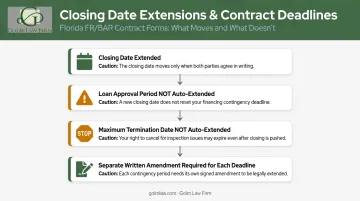
This is particularly consequential for buyers using financing. Florida Realtors' financing contingency guidance makes clear that extending the closing date does not automatically extend the loan approval period. The same logic applies to a maximum termination date: it must be separately amended, or it continues to govern regardless of other extensions.
Earnest Money When the Date Triggers
Once a maximum termination date triggers, the next question is what happens to the deposit. The answer depends on who caused the failure to close — and the contract does not simply award the money to whoever demands it first.
Under Paragraph 15(a) of the FR/BAR forms, when the buyer defaults, the seller may elect to:
- Retain the deposit as liquidated damages and full settlement, or
- Proceed in equity to enforce contractual rights
The seller is not automatically limited to keeping the deposit. Under Paragraph 15(b), when the seller defaults, the buyer may seek deposit return, damages, or specific performance. Which remedy applies depends on who caused the delay and what the contract allows.
What Happens If the Maximum Termination Date Passes?
How the Contract Language Determines What Comes Next
Scenario 1 — Contract contains automatic termination language: The agreement ends on that date. Neither party needs to serve notice. The contract is over, and the parties move to the question of who is entitled to the earnest money based on which party caused the failure.
Scenario 2 — Contract lacks automatic termination language: One party is likely in breach, but the contract remains technically enforceable. The non-defaulting party retains options: pursue remedies, negotiate a resolution, or serve formal notice depending on what the contract requires.
The Trinity Quadrille, LLC v. Opera Place, LLC decision from Florida's Fourth District Court of Appeal illustrates the second scenario. A contract with a March 15, 2007 closing date made time of the essence — yet when the buyer refused to close, the court found breach and anticipatory repudiation, not automatic termination.
The outcome turned on the seller's ability to cure a title issue within the contractual cure period. The court analyzed breach, not expiration — a critical distinction that shapes what remedies are available.
Legal Options for the Non-Defaulting Party
When a maximum termination date passes due to the other party's failure, the non-defaulting party generally has three paths:
- Retain the earnest money deposit — available to the seller when the buyer defaults and the contract permits retention
- Seek specific performance — ask a court to force the transaction to proceed
- Sue for damages — pursue monetary compensation for losses caused by the breach
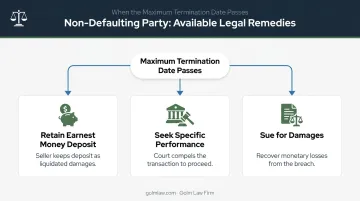
The FR/BAR forms do not limit the non-defaulting party to deposit retention alone. The election of remedies under Paragraph 15 lets the non-defaulting party choose between keeping the deposit, compelling performance, or recovering actual losses — depending on the circumstances and the damages at stake.
Choosing to act is the key. Waiting without a written demand, termination notice, or extension amendment creates a different problem entirely.
The Risk of Doing Nothing
If neither party acts after a missed date — no written termination, no extension amendment, no formal demand — the contract's legal status becomes genuinely ambiguous. Both parties may believe the deal is dead while technically remaining bound. This inaction often leads to escrow disputes, mediation, or litigation over who is entitled to the earnest money.
When a dispute arises over a contested deposit, Florida's escrow rules under Section 475.25 require the broker holding funds to notify FREC within 15 business days of receiving conflicting demands and to initiate a settlement procedure — escrow disbursement order, arbitration, mediation, or interpleader — within 30 business days.
Extending the Closing Date: Rules and Limits
What Makes an Extension Valid
Under Standard P of both FR/BAR forms, any modification to the contract must be in writing and executed by the parties intended to be bound. This means:
- Verbal agreements to extend are not enforceable
- An email from one agent to another does not constitute a binding amendment
- Both buyer and seller must sign the written extension for it to be valid
Florida's Statute of Frauds (Section 725.01) reinforces this — an action on a contract for the sale of land requires a signed writing. The Florida Supreme Court's decision in DK Arena, Inc. v. EB Acquisitions I, LLC (2013) further establishes that promissory estoppel cannot be used to circumvent the Statute of Frauds in land-sale contract modifications.
Common Reasons Extensions Are Needed
Lender-caused delays are among the most frequent triggers for extension requests. Other common reasons include:
- Appraisal delays or low appraisals requiring renegotiation
- Title issues that require clearance before closing
- Inspection repairs that take longer than anticipated
- Survey corrections or survey exceptions
- Buyer's loan underwriting conditions that require additional documentation
Buyers who anticipate delays should contact their agent and attorney early. Waiting until the closing date to request an extension puts the seller in a position to refuse or demand concessions.
The Problem With Extending Only the Closing Date
A closing date extension that does not address a separately stated maximum termination date may not be sufficient. Under Standard P, changing only the closing date leaves any other stated deadline unchanged. If the contract includes a bespoke maximum termination date that predates or coincides with the new closing date, that provision continues to govern unless it is also expressly amended.
Failing to amend the maximum termination date alongside the closing date can leave buyers exposed to contract termination even after both parties believed they had agreed to more time.
How to Protect Yourself When Signing a Purchase Agreement
For Buyers
Before signing, understand exactly what deadlines the contract contains and what triggers a loss of your earnest money. Specifically:
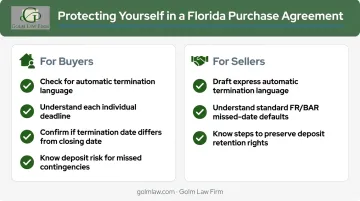
- Does the contract include automatic termination language, or does it require notice?
- What does "time is of the essence" mean for each individual deadline in your agreement?
- Is the maximum termination date the same as the closing date, or is it a separate provision?
- What happens to your deposit if you miss a financing or inspection deadline?
The FR/BAR forms are detailed documents. A buyer who signs without understanding the termination and default provisions is taking on risk that a single conversation with an attorney could eliminate.
For Sellers
Sellers who want certainty should not rely on vague or soft closing date language. If you want the agreement to end automatically on a specific date without requiring you to serve a termination notice, that mechanism must be expressly drafted into the contract.
Key considerations for sellers:
- Work with your attorney to include clear automatic termination language if deal certainty matters to you
- Understand that under the standard FR/BAR forms, a missed closing date alone does not end the contract
- Know what steps you must take — and how quickly — to preserve your right to retain the deposit if the buyer defaults
The Value of Attorney Review Before Signing
The FR/BAR forms contain nuanced provisions on termination, default, remedies, and deadline interactions that are easy to misread — and expensive to discover after the fact. The Florida Bar recommends consulting a Florida-licensed real estate attorney before signing any purchase agreement.
Golm Law Firm, based in Bradenton and serving buyers, sellers, investors, and developers across Florida, offers structured legal support at transparent flat rates:
- 60-minute consultation with document review — $350 (includes attorney review of your purchase agreement before the meeting; fee applies toward any flat-rate service if you retain the firm)
- Buyer or seller representation — $1,500 flat rate for full transaction support
- Pre-litigation services — starting at $550 for limited scope matters; $750 for hybrid flat-rate/hourly representation
If a deposit dispute has already arisen over a missed deadline or earnest money retention, the firm's dual role as both escrow agent and closing attorney — with funds held in a Florida Bar-regulated IOTA trust account — means the firm can typically resolve those disputes more efficiently than when a separate title company holds the funds.
Frequently Asked Questions
What is a termination date in real estate?
A termination date is a contractual deadline by which a transaction must close or a specific obligation must be fulfilled. Some contracts include language stating the agreement "automatically terminates" if this date passes; others require one party to take formal action to end the contract. The effect depends entirely on the specific language used.
How many times can a buyer extend the closing date?
Florida law sets no numerical cap on closing date extensions. Each extension must be agreed to in writing and signed by both parties. If the contract contains a maximum termination date, extending the closing date alone will not push the deal past that hard deadline — amending the maximum termination date provision is also required.
What is the 3-3-3 rule in real estate?
No Florida statute, FR/BAR form, or Florida Bar publication defines a "3-3-3 rule" in real estate. The phrase appears on general real estate blogs as an informal heuristic, but it carries no legal authority in Florida. Buyers and sellers should rely on the actual deadlines written into their purchase agreement, not informal rules of thumb.
What does "time is of the essence" mean in a Florida real estate contract?
It means the deadlines in the contract are treated as material terms. Missing a specified date by even a single day can constitute a breach. Both Rev. 12/24 FR/BAR forms include this language in Standard F, so it applies to all parties using those forms without any additional drafting required.
Can a seller cancel a contract if the buyer misses the closing date in Florida?
Not automatically. Under Florida law and the standard FR/BAR forms, the seller must take formal steps, including providing written notice where required, to declare a default and elect remedies. Without express automatic termination language in the contract, a missed closing date alone does not end the deal.
Is earnest money at risk if the maximum termination date passes?
Yes, potentially. If the buyer's failure to close caused the termination, the seller may have the right to retain the deposit as liquidated damages under the FR/BAR forms. The outcome depends on the contract language, which party caused the delay, and whether proper termination procedures were followed. Escrow agents cannot release disputed funds based on a date alone; a formal settlement procedure is required.