Florida's rules around who can prepare real estate contracts are stricter than many sellers realize. Getting this wrong doesn't just delay your closing; it can expose you to post-sale liability, earnest money disputes, or a deal that falls apart entirely.
This article covers the three realistic options for who draws up a Florida FSBO contract, what the contract must include, who pays for it, and why early attorney involvement is the single most cost-effective decision you can make in a private sale.
Key Takeaways
- A Florida FSBO contract can be prepared by a real estate attorney, the buyer's agent using a pre-approved form, or the seller
- Florida law prohibits non-attorneys from drafting original contract language; agents may only fill in pre-approved standardized forms
- Every valid Florida FSBO contract must address purchase price, financing terms, contingencies, required disclosures, and escrow arrangements
- Earnest money must be held by a neutral third party — a licensed attorney, title company, or licensed broker — not by either party directly
- Attorney fees for FSBO contract preparation are a fraction of a typical listing commission
What Is a FSBO Transaction in Florida?
A for sale by owner transaction means the seller lists, markets, and negotiates the sale of their property without a listing agent or broker. The primary motivation is straightforward: avoiding the listing agent's commission, which can represent a significant portion of a home's sale price.
What sellers often underestimate is how much work a listing agent handles behind the scenes. In a FSBO deal, all of the following shift directly to the seller:
- Pricing analysis and comparable market research
- Marketing the property and fielding buyer inquiries
- Qualifying buyers and negotiating offers
- Preparing and managing transaction paperwork
That paperwork piece is where FSBO transactions get legally complicated. Without a seller's agent, no one is automatically assigned to prepare the purchase agreement. According to NAR's 2025 Profile of Home Buyers and Sellers, FSBOs now represent just 5% of U.S. home sales — an all-time low — and difficulty managing the paperwork and legal requirements is consistently cited as one of the primary challenges driving sellers toward agent-assisted transactions.
Who Draws Up the Contract in a Florida FSBO Sale?
Florida law shapes this answer more than most sellers expect. The state's unauthorized practice of law rules — backed by Section 454.23 of the Florida Statutes, which makes unlicensed law practice a third-degree felony — draw a clear line between what a real estate agent can do and what requires a licensed attorney. Three realistic options exist for FSBO sellers navigating this.
Option 1: A Florida Real Estate Attorney (Recommended)
Retaining a Florida-licensed real estate attorney to draft the purchase agreement is the most legally sound path for any FSBO seller.
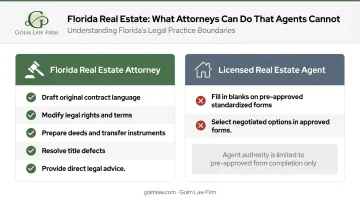
Unlike licensed agents, attorneys can:
- Draft original contract language and custom clauses
- Modify legal rights and terms to reflect negotiated terms
- Prepare deeds and other transfer instruments
- Resolve title defects
- Advise you directly on your legal position throughout the transaction
The controlling case law here is Keyes Co. v. Dade County Bar Ass'n (1950), where the Florida Supreme Court drew a clear line: brokers may prepare preliminary transaction papers, but the instruments that effectuate a transfer — and anything involving legal customization — belong with an attorney. For most FSBO sellers, attorney fees for contract drafting run $475–$1,200 flat — a fraction of what a disputed contract costs to unwind.
Option 2: The Buyer's Agent (Using a Pre-Printed Form)
If you have no agent and no attorney, the buyer's agent may prepare the offer using a standardized pre-approved form — most commonly the FloridaRealtors/FloridaBar "AS IS" Residential Contract for Sale and Purchase (Version 7, Rev. 12/24) or the standard Residential Contract for Sale and Purchase.
Florida law permits licensed agents to fill in factual blanks and select negotiated options in approved routine forms. What agents cannot do: invent legal clauses, modify legal rights, prepare a deed, or give legal advice.
When a buyer's agent prepares the contract, that document is written with the buyer's interests in mind — not yours. The seller has no advocate in that transaction. Florida also allows for transactional brokerage — where an agent facilitates a deal without exclusively representing either party — but even then, the seller should have any buyer-prepared document reviewed by their own attorney before signing.
Option 3: The Seller Themselves
Florida law does not prohibit a property owner from completing a contract for their own sale. A seller can use a pre-printed standardized form without running afoul of the unauthorized practice of law rules.
The real exposure is practical, not legal:
- Online templates rarely account for Florida-specific disclosure obligations
- Missing contingency language can trap you if the buyer backs out
- An incorrect legal description or omitted disclosure can delay or collapse the closing
- Post-sale liability is a real exposure if required disclosures aren't made
If you're considering this route, have a Florida real estate attorney review the contract before presenting it to the buyer. Errors in a signed real estate contract are difficult and expensive to correct. Golm Law Firm offers a 60-minute consultation with document review for $350 — credited toward any flat-fee service if you retain the firm — specifically for situations like this.
What Must a Florida FSBO Contract Include?
A valid Florida FSBO purchase contract must cover several distinct areas. Missing any of them creates problems at or after closing.
Core Contract Terms
- Full legal names of buyer and seller
- Complete property address and legal description matching the deed and county records
- Agreed-upon purchase price
- Anticipated closing date and possession terms
Financing and Earnest Money
- Whether the buyer is paying cash or obtaining financing (with loan type and amount if applicable)
- Earnest money deposit amount and who holds it in escrow
- Conditions under which the deposit is refundable or forfeited
Under Florida law, earnest money must be held by a neutral escrow holder — a licensed real estate attorney, title company, or licensed broker. Neither party holds it directly. Brokers must deposit funds into escrow by the end of the third business day after receipt under FREC Rule 61J2-14.008.
Required Contingencies
- Financing contingency — buyer's right to cancel if mortgage approval fails
- Inspection contingency — buyer's right to inspect and negotiate or withdraw
- Appraisal contingency — protects buyer if property appraises below purchase price
- Any deal-specific contingencies (home sale contingency, etc.)
The Florida Realtors/Florida Bar "AS IS" contract is widely used because it shifts greater responsibility to the buyer for property condition — but sellers should understand what that shift actually means before agreeing to it.
Florida Disclosure Requirements
Florida sellers have a legal duty to disclose all known material defects that aren't readily observable. This comes from Johnson v. Davis, the Florida Supreme Court case that established the rule for residential sellers — and an "AS IS" clause does not eliminate that obligation.
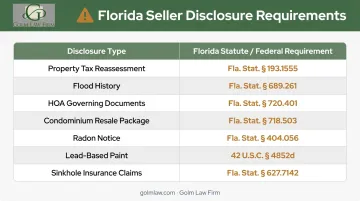
Depending on your property, additional disclosure forms may be required:
| Disclosure | Florida Law |
|---|---|
| Property tax reassessment warning | Fla. Stat. § 689.261 |
| Flood history and flood insurance | Fla. Stat. § 689.302 (enacted 2024, amended 2025) |
| HOA governing documents | Fla. Stat. § 720.401 |
| Condominium resale package | Fla. Stat. § 718.503 |
| Radon notice | Fla. Stat. § 404.056(5) |
| Lead-based paint (pre-1978 homes) | Federal EPA requirements |
| Paid sinkhole insurance claims | Fla. Stat. § 627.7073 |
Title and Closing Terms
The contract must address how title and closing will be handled, including:
- Who selects and pays for title insurance
- Which title company or closing agent manages the transaction
- How closing costs are divided between buyer and seller
- That transfer will occur via a statutory warranty deed, the standard in Florida residential sales under Fla. Stat. § 689.02
Who Pays the Cost of Drawing Up the FSBO Contract?
In a traditional transaction, contract preparation is embedded in the listing agent's commission paid at closing. In a FSBO deal, the cost depends entirely on who drafts the document.
When the seller retains an attorney, the fee is the seller's responsibility, typically paid at or before closing. Golm Law Firm charges a $1,200 flat rate for FSBO legal services, covering contract preparation, riders, and required disclosure documents — with no billing surprises.
When the buyer's agent prepares the contract instead, document preparation costs may be nominal, but the seller may still be asked to compensate that agent at closing. Since August 17, 2024, NAR settlement changes require buyer brokers to have written agreements specifying their compensation — something sellers should address directly in the contract rather than discover at closing.
Attorney fees for FSBO contract preparation represent a fraction of what a listing commission would cost on a typical Florida home sale. A seller keeping $15,000–$30,000 in commission savings who spends $1,200 on professionally drafted documents has covered that cost many times over — with legal protection the commission-free route doesn't automatically include.
Why Florida FSBO Sellers Should Work with a Real Estate Attorney
Florida does not legally require an attorney to close a residential real estate transaction. That fact leads many FSBO sellers to skip legal representation — and it's a consequential mistake.
The purchase contract is the document that governs everything: your rights if the buyer defaults, your liability if a disclosure is missed, and your exposure if a title issue surfaces. Getting it wrong costs far more than getting it right from the start.
What a Florida Real Estate Attorney Does That an Agent Cannot
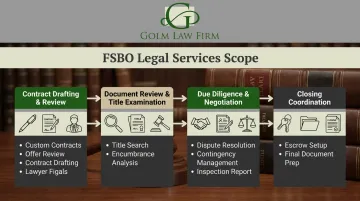
A firm like Golm Law Firm provides a scope of services in FSBO transactions that extends beyond what any licensed agent can offer:
- Drafts the full contract and all addenda from scratch, with custom clauses tailored to your transaction
- Ensures all Florida-specific disclosure obligations are met — including the 2024/2025 flood disclosure requirements
- Holds earnest money in a Florida Bar-regulated IOTA trust account, providing attorney-level accountability
- Conducts title search, examination, and clearance — resolving defects before they freeze your closing
- Prepares closing documents and coordinates the actual closing
- Provides direct legal advice throughout the transaction
Specific Risks Without Legal Representation
- Improperly drafted contingencies that leave you legally obligated to close even when the buyer backs out under unclear terms
- Missing disclosures that create post-sale liability — Johnson v. Davis imposes this duty regardless of an "AS IS" clause
- Earnest money disputes with no neutral escrow holder and no clear mechanism for resolution
- Title issues discovered late in the process that delay or collapse the deal on closing day
Each of these risks is addressable — before the contract is signed, not after a problem surfaces. Golm Law Firm's flat-rate FSBO contract service starts at $1,200, a fraction of a traditional listing commission on a property worth hundreds of thousands of dollars. Early attorney involvement is simply the lower-cost option.
Frequently Asked Questions
How much does it cost to have a sales contract drawn up for a FSBO sale?
Attorney fees for FSBO contract drafting vary by scope and complexity. Golm Law Firm charges a $1,200 flat rate covering the contract, riders, and required disclosure documents — with no hidden fees. Title work and closing coordination are quoted separately or bundled with closing fees.
Who holds earnest money in a FSBO transaction?
In Florida FSBO transactions, earnest money must be held in escrow by a neutral third party — a licensed real estate attorney, title company, or broker — not the buyer or seller directly. Golm Law Firm holds funds in a Florida Bar-regulated IOTA trust account, providing attorney-level accountability.
Is selling FSBO a good idea?
FSBO can save sellers significant money in listing commissions, but it requires handling pricing, marketing, negotiations, and all legal paperwork independently. It works best for sellers who are well-prepared and have professional legal support for contract preparation and closing.
Can a Florida FSBO seller use a pre-printed contract form?
Yes. Florida sellers may use standardized forms such as the FloridaRealtors/FloridaBar Residential Contract (Version 7, Rev. 12/24). However, even pre-printed forms require careful, accurate completion — having a Florida real estate attorney review the form before presenting it to the buyer is strongly recommended to catch errors or missing terms.
Does Florida require a real estate attorney to close a FSBO transaction?
Florida does not legally require attorney involvement in a residential real estate closing — it is a non-attorney-closing state in that limited sense. However, Florida prohibits non-attorneys from drafting original contract language, and given the financial and legal stakes, most FSBO sellers benefit from retaining an attorney for at least contract preparation and closing coordination.