Introduction: Why Every Business Tenant Needs a Commercial Lease Negotiation Checklist
A commercial lease is often the second-largest financial commitment a business makes, trailing only payroll. Yet most tenants sign the landlord's first draft with minimal pushback, not realizing that initial document was written entirely to protect the landlord's interests.
The result? Businesses locked into unfavorable terms for five, seven, or ten years. Unexpected CAM charges that double what they budgeted. Restoration obligations that cost tens of thousands at lease end.
This guide walks Florida business tenants through the full negotiation process: lease types, financial terms, overlooked clauses, and tactics that actually move landlords. It's built for markets like Bradenton, Sarasota, and Tampa, where retail vacancy sits at 3.4% in Tampa Bay and office vacancy runs above 18% — two very different negotiating environments that demand different strategies.
Key Takeaways
- A commercial lease is fully negotiable — preparation and market data are your strongest tools
- Know your lease type first — gross, net, and percentage leases carry fundamentally different cost profiles
- Rent is one line item; CAM charges, escalations, and operating costs determine what you actually pay
- Use, assignment, and restoration clauses can create major financial exposure if left unaddressed
- Attorney lease review pays for itself — catching one bad clause before signing can save thousands
Before You Start: Your Pre-Negotiation Preparation Checklist
Preparation matters as much as the negotiation itself. Tenants who arrive without defined needs, market data, and financial clarity are at a serious disadvantage against landlords and their attorneys.
Clarify Your Space and Business Requirements
Before evaluating any property, document what your business actually needs:
- Square footage : don't overestimate; unused space costs money every month
- Layout requirements — customer flow, storage, loading access, back-office space
- Parking and ADA accessibility — required for both operations and compliance
- Utility and infrastructure needs — HVAC capacity, electrical load, plumbing
Budget beyond base rent. Build-out costs, utilities, insurance, and CAM charges all factor into your true monthly occupancy cost. ICSC notes that retail occupancy costs approaching 12–13% of sales can erode profitability — model your full cost picture against realistic revenue before committing.
Research the Local Market
Market knowledge is negotiating leverage. Before approaching any landlord, gather:
- Comparable asking rents in your target area
- Current vacancy rates by property type
- What concessions landlords are actively offering (free rent, TIA, reduced CAM)
Florida markets vary significantly. Tampa Bay office vacancy hit 18.6% in Q4 2025, while retail vacancy was just 3.4% — a tenant in an office building has far more leverage than a tenant in a retail center right now. Sarasota retail vacancy stood at 3.9% in Q3 2025, trending downward.
Identify at least two or three alternative properties before entering negotiations. A competing option is one of the most effective tools a tenant can bring to the table.
Assemble Your Professional Team
Two professionals are worth engaging before negotiations begin:
- A tenant-rep commercial real estate broker — one who represents tenants, not landlords, with no conflicting incentives
- A commercial real estate attorney — to review the lease, flag legal risks, and ensure the terms you negotiate actually make it into the final document correctly
For Florida tenants in the Sarasota, Bradenton, or Tampa area, Crystal D. Golm and the team at Golm Law Firm offer flat-rate commercial lease review at $950. A $350 consultation (with document review) is available as a first step, and that fee applies toward the full service if you retain the firm.
Understanding Commercial Lease Types in Florida
Which lease type a landlord offers changes how every other term should be evaluated. Three structures dominate Florida's commercial market.
Gross Lease vs. Net Lease vs. Percentage Lease
| Lease Type | What Tenant Pays | Best For |
|---|---|---|
| Gross | Single flat rent; landlord covers most operating costs | Simpler budgeting; common in smaller office settings |
| Single Net | Base rent + property taxes | Moderate pass-through exposure |
| Double Net | Base rent + taxes + insurance | Higher variable exposure |
| Triple Net (NNN) | Base rent + taxes, insurance, and maintenance/CAM | Retail and commercial; broadest cost exposure |
| Percentage | Base rent + % of gross sales above a threshold | Shopping center retail |
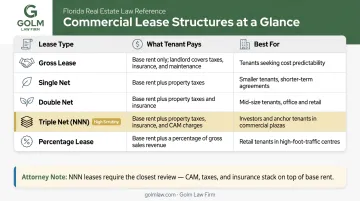
Triple net leases are common across Florida's retail and commercial markets — and they require the closest scrutiny because CAM charges, insurance, and tax obligations stack on top of base rent and can change substantially year to year.
For percentage leases, the breakpoint requires explicit negotiation. A natural breakpoint equals minimum rent divided by the percentage rate — for example, $45,000 ÷ 5% = $900,000. An artificially low breakpoint erodes margins during strong revenue periods, so pin down this number before signing.
Understanding which lease structure applies shapes every clause that follows — from CAM caps to renewal options and rent escalation terms.
The Core Commercial Lease Negotiation Checklist: Rent, Terms, and Operating Costs
These are the financial terms that determine what a tenant pays over the life of the lease and what rights they hold at the end of it.
Rent Structure and Escalation Clauses
Clarify not just the base rent figure, but exactly how and when it increases. Two common escalation mechanisms:
- Fixed annual percentage increases — predictable and easier to budget
- CPI-based increases — tied to the Consumer Price Index, which can spike unexpectedly
CPI clauses must specify the exact index, reference months, geography, and whether there's a floor or ceiling. The BLS publishes Miami-Fort Lauderdale-West Palm Beach CPI-U data, but that index doesn't prescribe any cap — that's entirely a negotiated term. Push for a defined annual ceiling on CPI-linked increases.
Rent abatement (a rent-free period during build-out) is a reasonable, standard ask — particularly for longer lease terms. It aligns your rent payments with actual business operations rather than construction timelines.
Lease Term and Renewal Options
Shorter terms offer flexibility; longer terms offer stability and negotiating power for better concessions. Match your lease length to your current business plan and realistic growth projections.
Nationally, CBRE reports average retail lease terms of 96 months through Q3 2024, with office leases averaging 86–107 months — multi-year commitments that require you to get the terms right before signing.
Renewal options must be negotiated upfront — not assumed. Specify:
- How rent will be set at renewal (fixed increase, CPI-adjusted with a cap, or fair market value with a defined ceiling)
- The notice period required to exercise the option (and the exact delivery method)
- Whether time is expressly of the essence for that notice deadline
Missing a renewal option deadline by even one day can cost you the right to stay.
Operating Expenses and CAM Charges
CAM charges are calculated as your pro-rata share of the leasable space — if you occupy 10% of a building, you pay 10% of covered costs. Those costs typically include:
- Parking lot maintenance and landscaping
- Common lobbies and shared-area utilities
- Security and property management fees
CAM varies widely. ICSC illustrates ranges from $2–$3/sq. ft. in neighborhood centers to over $50/sq. ft. in upscale lifestyle centers. That range explains why you need property-specific history, not market averages.
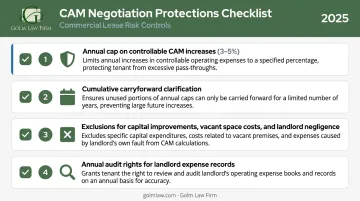
Negotiate these protections before signing:
- An annual cap on controllable CAM increases (practitioners typically target 3–5%)
- Clarity on whether unused cap amounts carry forward cumulatively — the answer matters more than most tenants realize
- Exclusions for capital improvements, costs tied to vacant spaces, landlord negligence, and leasing commissions
- The right to audit the landlord's expense records annually
Request 3–5 years of historical CAM statements and reconciliation reports. The pattern in those numbers tells you far more than the landlord's projected estimate.
Lease Clauses Tenants Frequently Overlook
These provisions get less attention during negotiations but can restrict operations or create significant unexpected costs — sometimes years after signing.
Use Clause
The use clause defines exactly what business activities are permitted on the premises. An overly narrow definition — "the sale of shoes" rather than "retail footwear and accessories" — can prevent you from adding services, product lines, or business pivots without landlord approval.
The Winn-Dixie v. Dolgencorp litigation, which involved restrictive grocery-exclusive language across 98 Florida stores, illustrates how use restrictions can have sweeping operational consequences when left unexamined.
Negotiate the broadest reasonable use definition. If you're in a multi-tenant property, also negotiate for exclusive use rights to prevent the landlord from leasing adjacent space to a direct competitor.
Assignment and Subletting Rights
These two rights are distinct:
- Assignment — transfers the entire lease to another party, which is critical if you sell the business
- Subletting — rents part of the space to a subtenant while you remain on the lease
Landlords typically require consent for both. Florida's Chapter 83 contains no express commercial assignment/subletting rule. Landlords typically require consent for both. Florida's Chapter 83 contains no express commercial assignment/subletting rule — Fernandez v. Vazquez, 397 So. 2d 1171 (Fla. 3d DCA 1981) applied good faith and commercial reasonableness where the lease required consent without granting absolute discretion, but parties can draft an absolute-discretion clause.
Negotiate language requiring that landlord consent "not be unreasonably withheld, conditioned, or delayed," with a defined response window of 15–30 days.
Tenant Improvement Allowance (TIA)
A TIA is a dollar amount the landlord contributes toward customizing the space — typically quoted per square foot. Average 2024 national office TIA ran $87.51/sq. ft., down from $97.55/sq. ft. in 2023 but still 30% above pre-pandemic levels, according to CBRE.
Before finalizing the lease, get contractor quotes so you can negotiate an adequate allowance. Also clarify:
- Whether the TIA covers only hard construction costs or also soft costs (architectural drawings, permits, fees)
- Disbursement conditions and documentation requirements
- What happens to unused TIA — does it revert to the landlord or convert to rent credit?
Golm Law Firm's commercial lease review covers TIA terms and disbursement conditions in detail — so there are no gaps in documentation before you sign.
Make-Good and Restoration Clauses
Many leases require tenants to restore the premises to original condition at lease end — removing all improvements and fixtures. Depending on what was built out, that obligation can run into tens of thousands of dollars.
Negotiate upfront that standard fixtures and built-out improvements become the landlord's property at lease end, minimizing your restoration obligations. Get that agreement documented explicitly in the lease itself, not just in emails.

Negotiation Strategies That Give Florida Tenants the Upper Hand
Anchor with Data, Not Emotion
Present comparable rental rates, vacancy data, and competing lease offers before the landlord's asking terms set the benchmark. In Tampa Bay's current office market — 18.6% vacancy, $31.47/sq. ft. full service — office tenants have documented data to support more aggressive positioning. Retail tenants in the same market face tighter conditions at 3.4% vacancy and need to pick their battles more selectively.
Create Win-Win Scenarios
Landlords are often willing to offer concessions in exchange for something they value:
- Longer lease term in exchange for lower base rent or more TIA
- A creditworthy personal guarantor in exchange for rent abatement
- Early signing in exchange for better CAM terms
Understand the landlord's priorities — whether that's occupancy stability, a specific tenant mix, or a guaranteed term length. Structure your requests to address those priorities while advancing your own. That alignment is usually where the real concessions live.
Know When to Walk Away
Having identified alternative properties during preparation gives you the credibility to walk away if terms remain unacceptable. Signing unfavorable terms under pressure locks you into years of financial exposure that no amount of rent concessions can offset. A commercial real estate attorney can help you assess whether a lease's overall risk profile is acceptable, not just whether the rent figure looks reasonable.
Before walking away, confirm you've reviewed:
- Whether exit clauses and termination rights are adequate
- Whether personal guarantee exposure is capped or unlimited
- Whether the landlord has room to negotiate or the deal is genuinely at its limit
Frequently Asked Questions
How do you negotiate a new commercial lease?
Start by defining your space needs, budget, and non-negotiable terms. Research comparable rates and identify alternatives before approaching the landlord. Bringing in a commercial real estate attorney and a tenant-rep broker before negotiations begin changes the dynamic significantly in your favor.
What questions should I ask when negotiating a commercial lease?
Ask about CAM coverage and the 3-year historical average, escalation terms and whether there's a cap, TIA amount and scope, assignment and subletting conditions, and your restoration obligations at lease end.
What is the 70/30 rule in negotiation?
The 70/30 rule suggests effective negotiators listen 70% of the time and speak 30%. In lease negotiations, tenants who ask more questions and listen carefully to the landlord's priorities are better positioned to craft proposals that work for both parties — rather than matching demand for demand.
What is a CAM charge in a commercial lease?
CAM (Common Area Maintenance) charges are your proportional share of costs to maintain shared property areas — parking lots, lobbies, landscaping, and building management. They're added on top of base rent and can increase annually, which is why negotiating an annual cap and reviewing historical CAM data before signing is essential.
What are the most common mistakes tenants make when signing a commercial lease?
The most damaging: focusing only on base rent while missing escalation clauses and CAM exposure; accepting the landlord's first draft without negotiating; signing a use clause too narrow for your business model; and skipping attorney review before signing.
Golm Law Firm, P.A. offers flat-rate commercial lease review services at $950, with consultation options starting at $150. Consultation fees are credited toward the full service if you retain the firm. Contact Crystal D. Golm and the team at (941) 704-4049 or visit the office at 1904 Manatee Ave. W., Suite 300, Bradenton, FL 34205, Monday through Friday, 9:00 AM – 5:00 PM.